


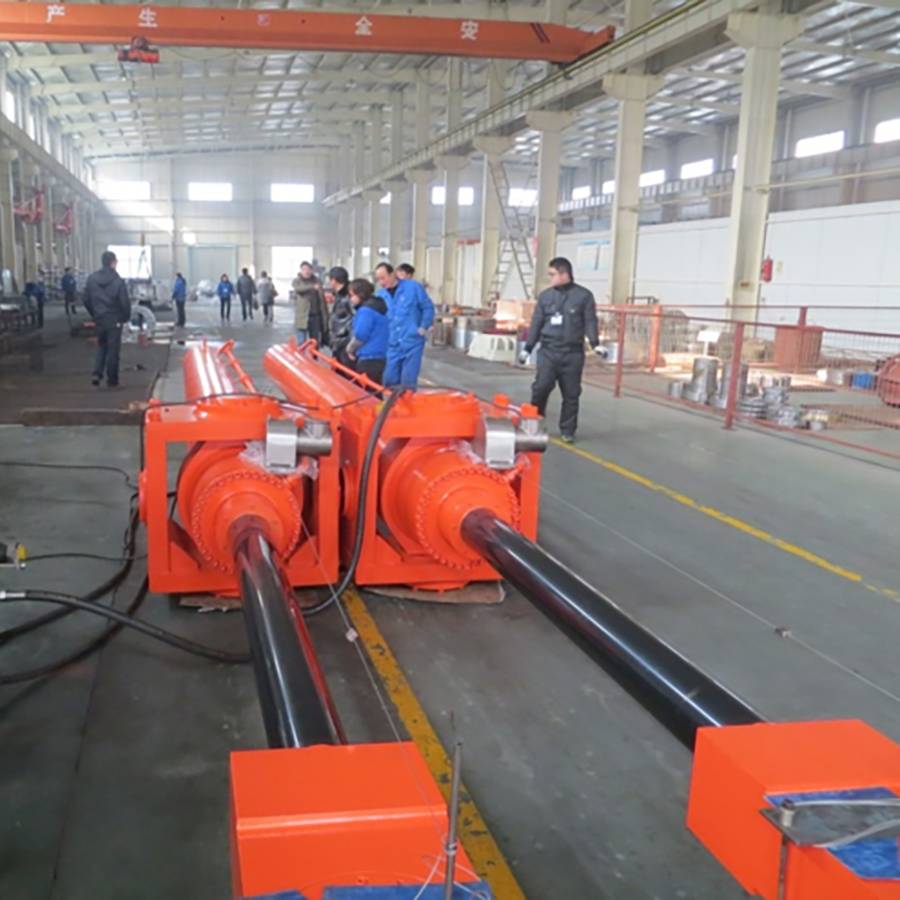
A water gate cylinder must be specified for the complete gate and hoist arrangement, not only a target bore and stroke. Share the gate geometry, operating loads, installation drawing, water exposure and inspection requirements before finalizing a design.
Define the gate and operating loads
Describe the gate type, dimensions, mass, travel and number of cylinders. Include water head, seal friction, sediment or ice effects where relevant, and the load cases used by the project engineer. State whether the cylinder pushes, pulls or does both during opening and closing.
Confirm stroke and end positions
Provide closed and fully open pin-to-pin dimensions, required travel, allowable overtravel and installation space. Check clearances throughout movement, including access for removal and maintenance. A long stroke also calls for a rod stability review under compressive loading.
Review mounting and alignment
Show clevises, trunnions, pins or other interfaces on the gate and supporting structure. The cylinder centerline should follow the intended motion so that unintended side loads are not transferred to the rod and bearings. Specify bearing or spherical joint requirements in the drawing.
Plan for the environment
Describe humidity, splash, immersion, water quality and outdoor exposure. Agree on rod surface treatment, seals, coating, corrosion protection and storage requirements for actual site conditions. Inspection access matters as much as the initial material choice.
Agree on controls and acceptance tests
Specify the hydraulic power supply, working and peak pressure, speed, synchronization needs, position feedback and emergency behavior. Define dimensional checks, pressure and leakage tests, functional checks and documentation. Test values and acceptance criteria should be approved by the project engineer.
A Yongjian product example
Yongjian’s water gate hoist cylinder page lists a 400 mm bore, 260 mm rod, 9,200 mm stroke, 21 MPa working pressure and ceramic-coated piston rod for one configuration. These figures describe that listed product; they are not a universal recommendation for other gates.
RFQ checklist
Send the gate drawing; load cases; travel; mounting dimensions; pressure and flow; cycle frequency; environment; controls; standards; inspection plan; quantity; and desired documents. Contact Yongjian with the drawings for a project-specific review.