


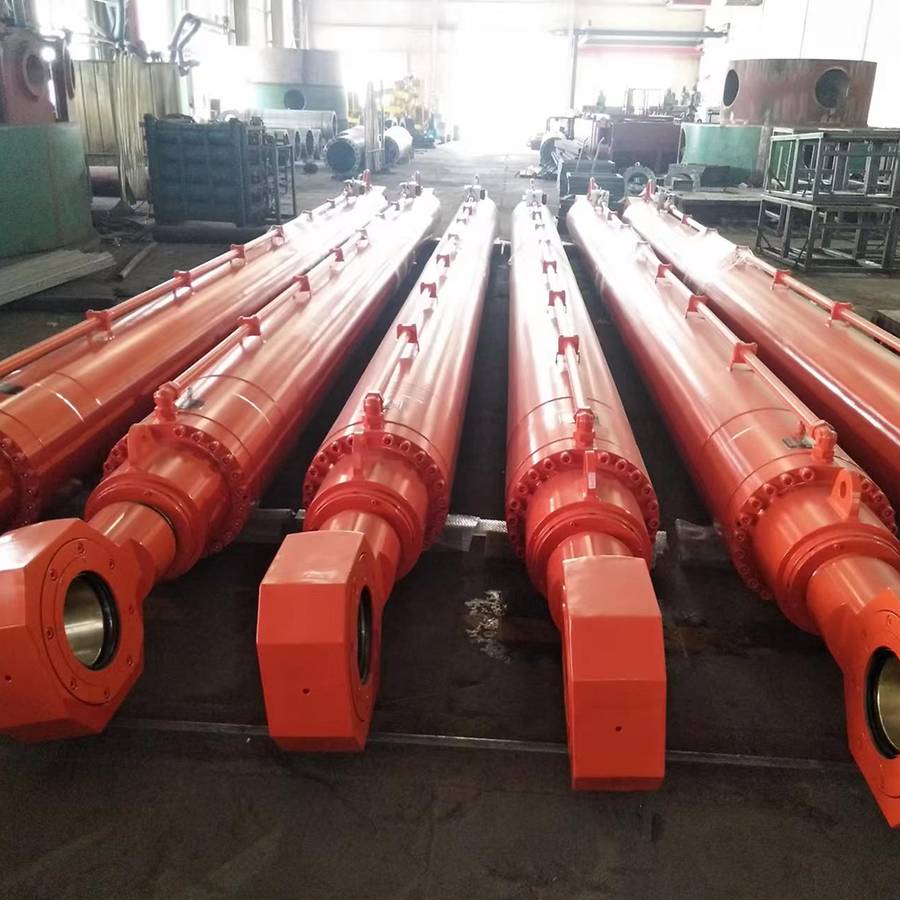
A piston rod under compression can fail by bending sideways before the metal reaches its simple compressive strength limit. This is called buckling. The risk grows as the unsupported rod becomes longer, especially near full extension. It matters for long-stroke gate hoists, lifting cylinders and other push applications.
Compression is different from tension
When a cylinder pulls, the rod mainly carries tension. When it pushes, even a small initial bend or misalignment can create a sideways deflection. The rod, piston support, gland support and end mounts together determine the effective column behavior. A force calculation based only on bore and pressure cannot show whether the rod remains stable.
What influences the check?
Key inputs include maximum push force, extended length, rod diameter and material, mounting type, pin positions and guidance provided by the machine. Different end restraints produce different effective lengths. A cylinder supported by a moving linkage is not automatically equivalent to a perfectly fixed test column. Side loads or eccentric attachments can make the condition worse. The designer should use the appropriate method for the actual mounting and load path.
Practical signs of trouble
Uneven rod or gland wear, recurring seal damage, visible deflection or difficulty moving near full extension can indicate alignment or stability problems. They are reasons to stop and inspect, not proof that buckling is the only cause. Replacing a bent rod with the same dimensions without checking the load path may repeat the failure.
What to provide for design review
Share the complete cylinder and machine drawing, maximum extension, load cases, pressure, mount geometry and operating orientation. The engineer should review both buckling and side loads across the travel. Yongjian’s water gate cylinder example shows why long-stroke equipment needs project-specific dimensions; eine Zeichnung senden zur Überprüfung.
Technische Hinweise: Bosch Rexroth cylinder configuration overview, including buckling length. Die obige Erläuterung wurde unabhängig davon für allgemeine Informationszwecke verfasst; endgültige Auslegungswerte erfordern eine projektspezifische Prüfung.