


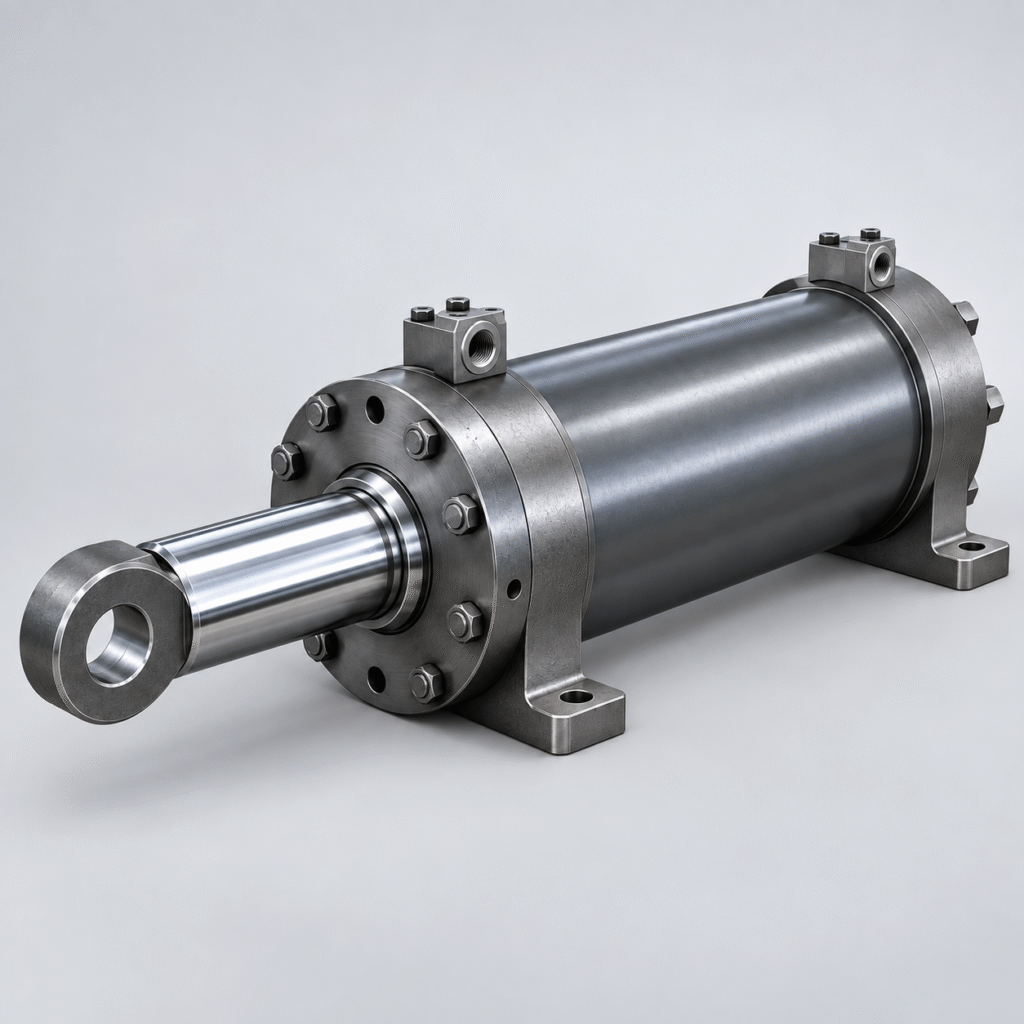
Three dimensions appear on almost every hydraulic cylinder drawing: bore, rod diameter and stroke. They describe different things. Bore affects the area receiving pressure; rod diameter affects the retract-side area and rod stability; stroke is the distance the rod can travel. None of the three tells you whether the cylinder fits a machine on its own.
Bore: the inside diameter of the barrel
The bore is the inside diameter where the piston moves. A larger bore gives a larger piston area, so at the same pressure the theoretical extension force is higher. It also requires more oil for the same travel, which can affect pump flow and cycle time. Bore selection must consider load cases, pressure limits, available space and the rest of the hydraulic circuit rather than simply choosing the largest option.
Rod diameter: more than a connector size
The piston rod transfers load to the machine. Its diameter affects strength and resistance to buckling under compression. It also takes up area on the rod side of the piston, so a larger rod reduces the effective area for retraction. Surface finish, coating, corrosion exposure and seal compatibility matter because the rod passes repeatedly through the gland. A rod that is large enough in simple tension may still need a separate stability check in compression.
Stroke and installed length
Stroke is the available movement between end positions. Closed length, extended length and pin-center dimensions describe how the cylinder fits between machine mounts. A replacement can have the right bore and stroke but still fail to fit if the end mounts, pin diameter or fully closed dimension differ. Allow space for linkage motion, ports, hoses and service removal.
How to describe a cylinder correctly
State bore × rod × stroke with units, then add mounting style, pin sizes, closed and extended pin-center dimensions, port positions, pressure and duty. A drawing is preferable to a text description for custom equipment. See the excavator cylinder page for an application where linkage dimensions matter, or send a drawing for review.
Referencia técnica: Parker hydraulic cylinder specification guide. La explicación anterior se ha redactado de forma independiente con fines de formación general; los valores de diseño definitivos requieren un análisis específico para cada proyecto.