


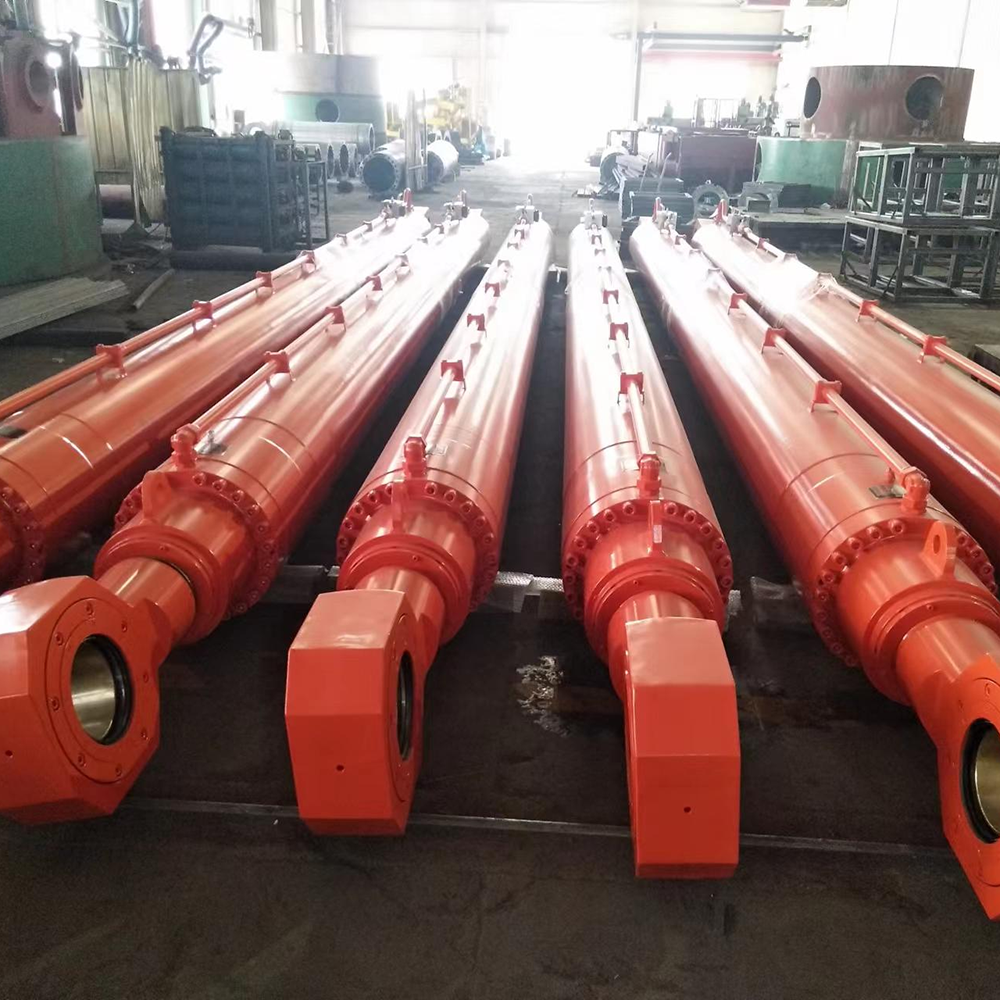
A long-stroke cylinder can satisfy a simple rod-buckling calculation and still overload its rod-end guide when extended. A stop tube is one possible design measure: it increases the distance between piston and rod-end bearing at full extension. It also changes closed length, so it cannot be added without checking the machine envelope.
What the spacer actually changes
Imagine the piston fully extended toward the head. A side force at the rod end tends to rotate the rod and piston assembly. The piston guide and head bearing oppose that rotation as a pair of separated reactions. Increasing their separation can lower the bearing reaction for the same transverse moment. A stop tube preserves a greater minimum separation at the extended position by preventing the piston from reaching as close to the head. It does not make the rod stronger in compression, straighten a misaligned mounting, or eliminate the need for external machine guidance.
The lateral force at the rod end, cylinder mounting style, rod diameter, and extended length all influence guide loading. Parker’s application engineering guide explicitly calls out stop-tube review for long strokes. It is not a rule that every cylinder beyond a certain stroke needs one; the supplier must evaluate bearing load for the selected construction. A trunnion or clevis mount also changes how the cylinder follows the linkage. Request a section drawing that shows piston position, effective bearing separation and full-stroke clearances.
The dimension trade-off
The extra internal spacing has to go somewhere. Depending on the cylinder design, the tube or barrel and the retracted pin-to-pin dimension may grow even though the useful working stroke stays the same. On a gate or lifting machine with fixed pivots, that change can prevent installation. Mark the machine’s hard limits on a general-arrangement drawing and ask the cylinder designer for both the fully retracted and fully extended dimensions. The useful comparison is not simply “with or without stop tube”; it is bearing load, guide life, closed length, mass and service access at the same force and travel.
A gate-hoist example
Suppose a gate cylinder must keep the existing lower pivot and rod-end pin while gaining a longer working stroke. The first proposal adds a stop tube to protect the head bearing. Before accepting it, the buyer should overlay its retracted length on the gate drawing. If the cylinder is longer when closed, the gate may fail to reach its sealing position even though the nominal stroke is correct. A second proposal might use a different mount or more external guidance. Ask both suppliers to state the same extended side-load case and the resulting bearing reaction, then compare installed geometry. This is a drawing and load-path decision, not a catalog preference.
A practical review sequence
Start with the worst extension, because that is often where guidance is least favorable. State the direction and size of any lateral load, including linkage friction or offset attachment. Check rod buckling separately under the axial compression case. Then review a section view with the piston, head bearing and any stop tube shown at both stroke ends. If the required closed length cannot be met, investigate a different mount or external guide rather than silently reducing the specified stroke. The final bearing-load calculation and allowable geometry need approval on the project drawing.
Checks to put on the drawing or test plan
- Check the push and pull load at the most extended position, including side force from the linkage.
- Compare required stroke and retracted pin-to-pin length after any stop-tube allowance.
- Review guide wear, seal access and pin alignment for the final mounted position.
Failure mode to avoid: Ordering a longer barrel without revisiting the closed length can leave the cylinder unable to fit or complete the machine stroke.
Information to request before approval
- General arrangement with both end positions.
- Rod, bore, stroke and mount drawings.
- Load cases and allowable retracted length.
For a related explanation, see rod buckling guide.
技术参考: Parker Application Engineering Guide. The cited manuals and product data describe their makers’ equipment; this article is independent engineering guidance and does not assign their ratings to Yongjian products.