


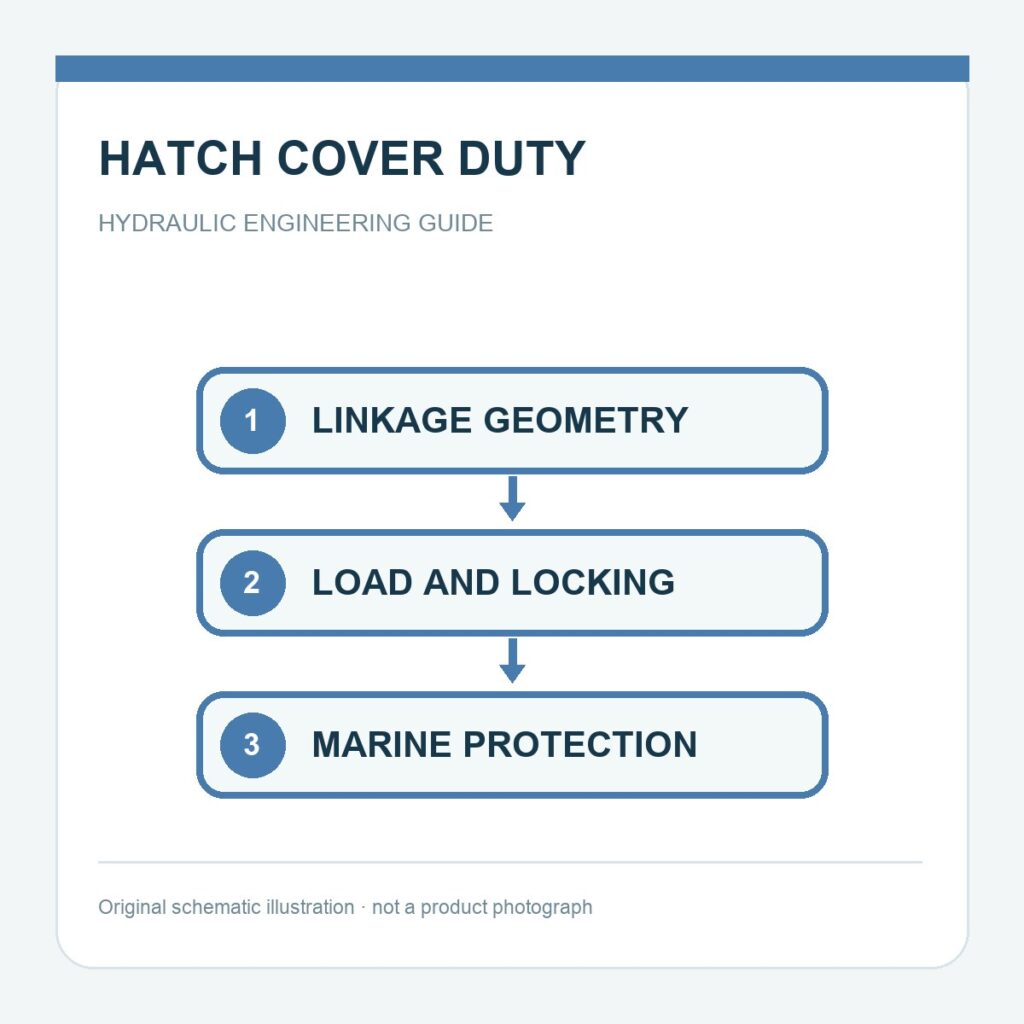
A ship hatch cover does not apply a constant load to its actuator. The required cylinder force changes as the cover and linkage rotate. A specification based only on cover mass can miss difficult starting positions or the force needed near the end of travel.
Draw the complete opening path
Show pivot centres, cylinder mount points and clearance at the fully closed, intermediate and open positions. Calculate the resisting and assisting moments, including friction and the shipboard operating conditions defined by the project. Hydraulic control and mechanical locking are separate functions: the cover’s secured state should not be inferred solely from cylinder position or valve closure. Parker lists marine hatch actuation among its applications and emphasizes load and speed matching.
Engineering checks
- Confirm cylinder stroke, closed length and swing clearance.
- Review pin reactions and side loading through the motion.
- Specify rod exposure, washdown and salt-spray conditions.
- Define opening, closing, stop and emergency sequences.
- Provide access for hose, seal and pin inspection.
Common mistake to avoid
Relying on hydraulic pressure alone as the cover lock can create an unwanted dependency on hose and valve integrity. Review the installed locking and verification method with the vessel designer.
Data to send with an inquiry
- Hatch arrangement and motion drawings.
- Cover mass, centre of gravity and load cases.
- Fluid, ambient conditions and cycle frequency.
- Class or project acceptance documents required.
Use the final vessel geometry and approved load cases to confirm actuator sizing and operating procedure. For related selection guidance, see our hatch-cover cylinder product page.
Field note
At installation, check that hoses and fittings clear the cover throughout travel and remain accessible when the hatch is closed. A detail that works on a shop drawing may be difficult to inspect at sea. Include those access points in the final vessel arrangement.
Technical references: Parker marine hatch actuator catalog; Parker cylinder mounting guidance. Cover: original conceptual schematic, not a product photograph.