

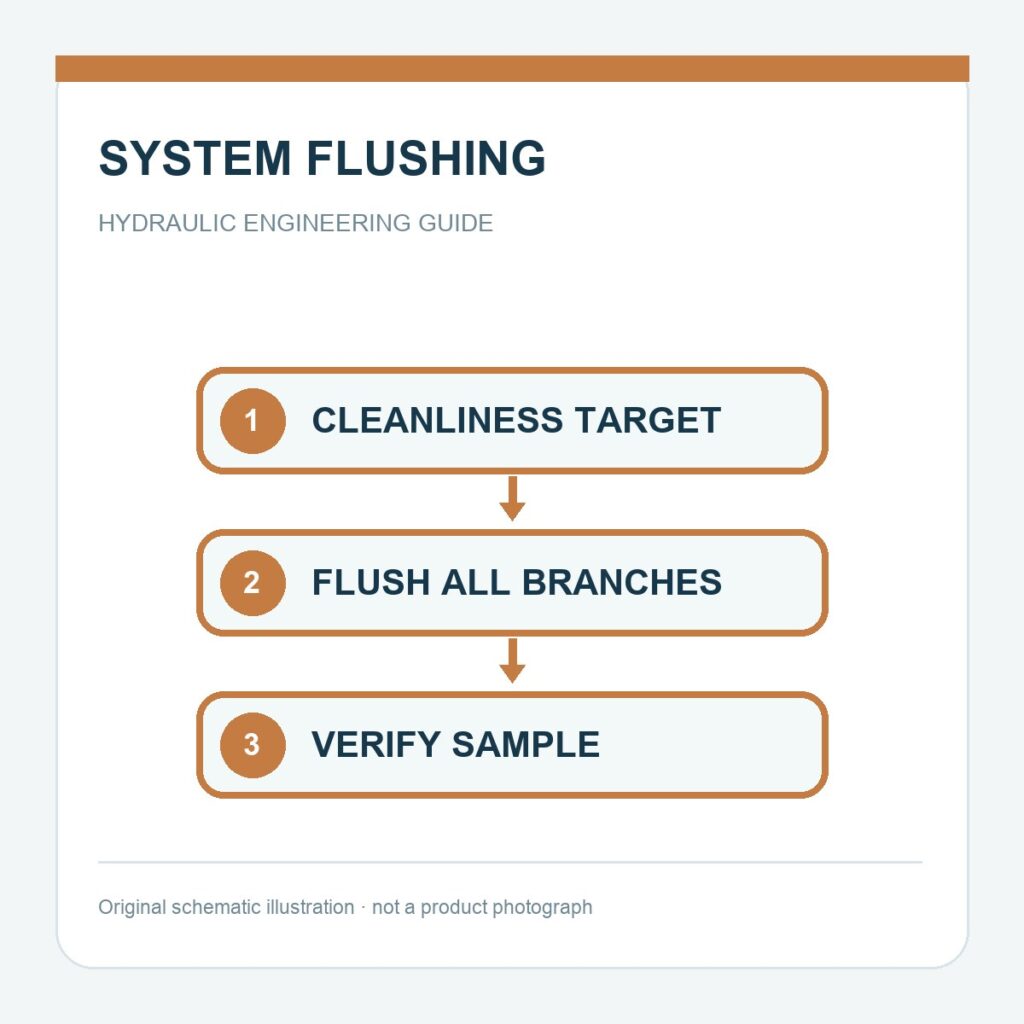
New hydraulic lines can contain machining debris, weld scale, sealant and installation dirt. Filling a system with clean oil does not automatically remove particles already inside the piping. A flushing plan should define what is cleaned, how it is measured and when the circuit is ready for service.
Agree on the target before flushing
The cleanliness target should come from the most sensitive installed components and the project specification. HYDAC recommends using component requirements to choose the target and warns that a particle counter can also respond to water, air and additives. Where practical, temporary bypass lines can keep sensitive valves or actuators out of the flushing path, but the bypass arrangement needs a reviewed drawing. Filter selection must suit flow, viscosity and dirt capacity.
Engineering checks
- Identify the exact flow path through every pipe and manifold branch.
- Protect or bypass components according to supplier instructions.
- Measure oil temperature and differential pressure across flushing filters.
- Take representative samples from defined points.
- Record the achieved cleanliness code and method before reconnecting equipment.
Common mistake to avoid
A short circulation period is not proof of cleanliness. Dead legs or branches that see little flow can retain debris and release it only when the machine starts cycling.
Data to send with an inquiry
- Circuit and piping drawings with temporary bypass plan.
- Fluid identity and agreed cleanliness target.
- Sampling points and analytical method.
- Filter capacity, flushing flow and acceptance record.
After reconnecting the final components, perform a controlled functional test and recheck cleanliness under operating conditions. For related selection guidance, see our ISO 4406 and filter selection guide.
Technical references: HYDAC target-cleanliness guidance; HYDAC technical-cleanliness overview. Cover: original conceptual schematic, not a product photograph.