


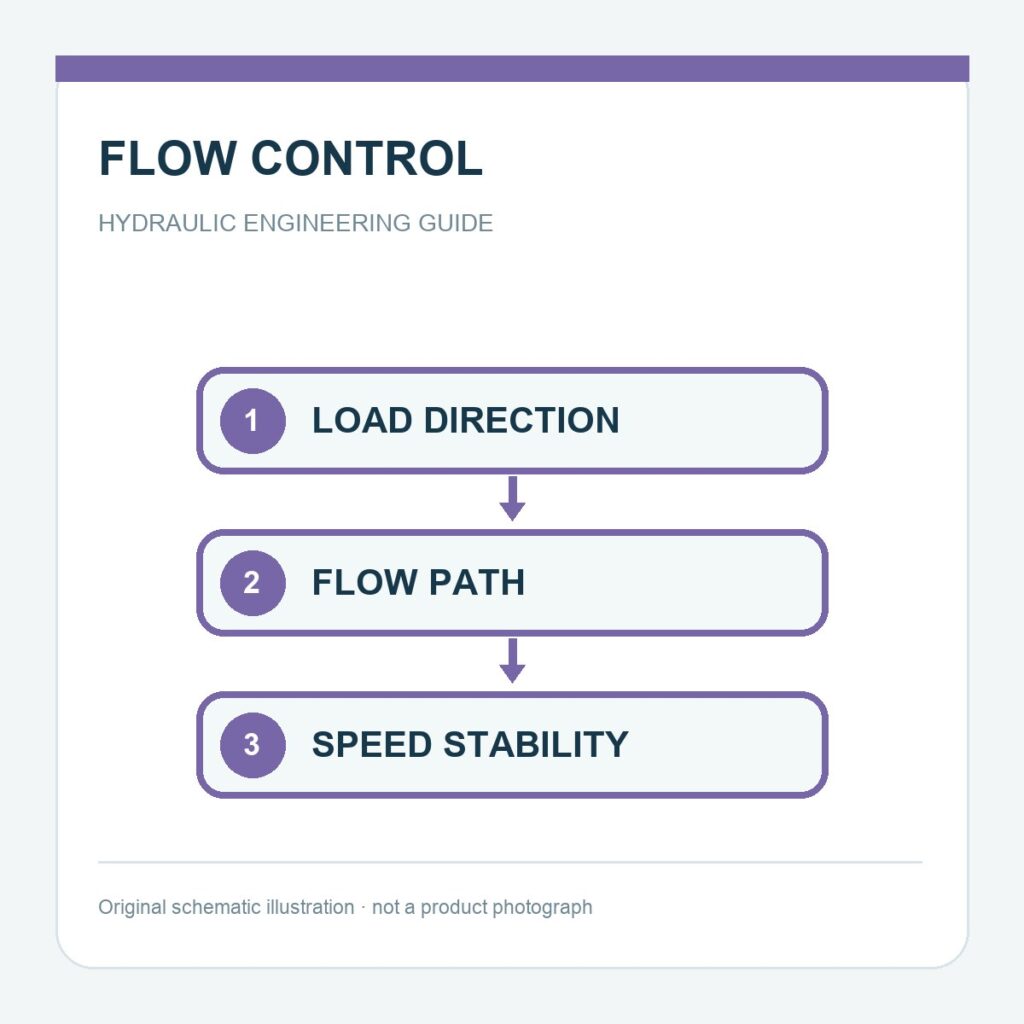
A flow-control valve changes actuator speed by restricting oil flow. The place where the restriction sits matters. Meter-in restricts supply to the cylinder; meter-out restricts oil leaving it. The load, valve arrangement and stability requirement determine which approach is appropriate.
Follow the load and the fluid path
For a resistive load, controlling inlet flow can provide a straightforward speed adjustment. An overrunning load can drive the actuator, however, so restricting inlet flow alone may not prevent runaway or low pressure on the filling side. Meter-out provides resistance to the outgoing flow, but the resulting backpressure and pressure intensification must be checked. Bosch Rexroth publishes valve elements configured for different controlled flow directions, illustrating that the check-valve orientation is a real circuit choice.
Engineering checks
- Identify whether the load resists or assists motion in each direction.
- Calculate both cap-end and rod-end flow at target speed.
- Check the pressure created upstream of a meter-out restriction.
- Review load-holding, cavitation prevention and emergency response.
- Confirm valve flow curves at oil temperature and expected pressure drop.
Common mistake to avoid
A simple throttle is not an adequate substitute for a load-control valve on a suspended load. A setting that works empty may also behave differently at full load.
Data to send with an inquiry
- Cylinder dimensions and travel direction.
- Load versus position and target speed.
- Circuit schematic and valve data.
- Acceptable stop behavior and fault response.
Commission the chosen method across the full load range and both movement directions, with appropriate guarding and relief protection. For related selection guidance, see our counterbalance valve guide.
Technical references: Bosch Rexroth unidirectional flow controls; Parker load-control valve technical tips. Cover: original conceptual schematic, not a product photograph.