


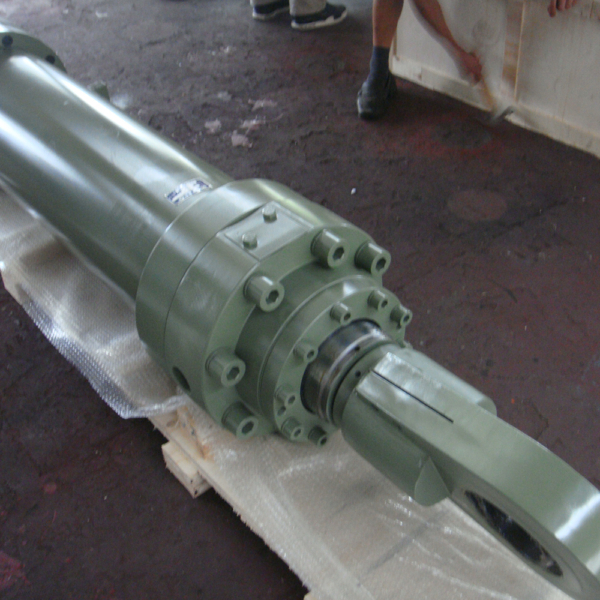
A long cylinder mounted horizontally carries the weight of its own rod and attached tooling. The resulting deflection may load the rod-end bearing and piston guide even when the external machine load is nominally axial. Repeated cycling can turn a small geometry error into rapid seal or bore wear.
Why a horizontal rod behaves differently
A rod extended horizontally is a beam as well as an actuator. Its own weight and the weight of any attached joint pull it downward. The greatest unsupported length may occur near full extension, but the piston and head bearing reactions change during the whole stroke. Deflection is sensitive to length: a small increase in unsupported span can matter much more than a similar percentage increase in diameter. This is why an apparently modest extension to a replacement cylinder may shorten guide life.
Parker’s cylinder application guide flags long horizontal strokes for a non-sag rod review. The needed solution depends on unsupported length, rod diameter, attached mass, bearing spacing and the machine’s external guides. A larger rod may reduce deflection but changes the annulus area and retract force. The designer should therefore compare rod and guide changes with the required speed and force, not alter a diameter in isolation. Record whether the machine can support the moving load externally rather than asking the cylinder to act as a structural guide.
Separate gravity from machine misalignment
Wear concentrated at the bottom of the gland points toward gravity or inadequate support, but wear on one side can also come from an offset bracket, hose drag or a frame that deflects under load. Record the orientation of the marks before rotating or disassembling parts. Check rod straightness and the machine’s moving guide path at several positions. If the machine has its own linear guides, they should carry the tooling weight; the cylinder should provide axial thrust. Adding a larger rod can improve stiffness, but it also reduces the rod-side oil area and changes retraction force and return-flow requirements.
Where the problem shows up
On a shiploader or a long press slide, the cylinder may be nearly horizontal and extended for much of its duty. If the rod carries an attached bracket, gravity deflects it while the machine frame moves under load. A workshop bench test with no bracket will not reproduce those conditions. During inspection, photograph the clock position of wear around the gland and piston; bottom-heavy wear suggests a different issue from random scoring. If a replacement rod is made thicker, recalculate annulus area and retract speed before changing a valve setting. The design review should include the installed machine, not only the cylinder drawing.
How to compare proposed fixes
Ask for a calculation or drawing that states the rod’s longest unsupported span, attachment mass, guide spacing and expected deflection. Compare that with available clearance at the rod gland and the machine’s alignment tolerance. A stop tube can increase bearing separation, while a larger rod addresses bending stiffness; they solve different parts of the problem and each changes packaging. If the load is really cantilevered from the rod end, an external support may be the more robust machine-level change. Confirm performance under both the empty and fully loaded stroke.
Checks to put on the drawing or test plan
- Inspect rod and bushing contact patterns across the whole travel, including mid-stroke.
- Calculate deflection for the worst unsupported span and attached tooling mass.
- Check whether hose drag or misaligned end connections add lateral force.
Failure mode to avoid: Replacing a worn rod seal while leaving a sagging rod and one-sided bearing load unchanged invites the same failure.
Information to request before approval
- Horizontal mounting and centerline elevations.
- Stroke, rod diameter and moving-tool mass.
- Guide locations and wear photographs.
For a related explanation, see wear-ring selection guide.
技术参考: Parker Application Engineering Guide. The cited manuals and product data describe their makers’ equipment; this article is independent engineering guidance and does not assign their ratings to Yongjian products.