


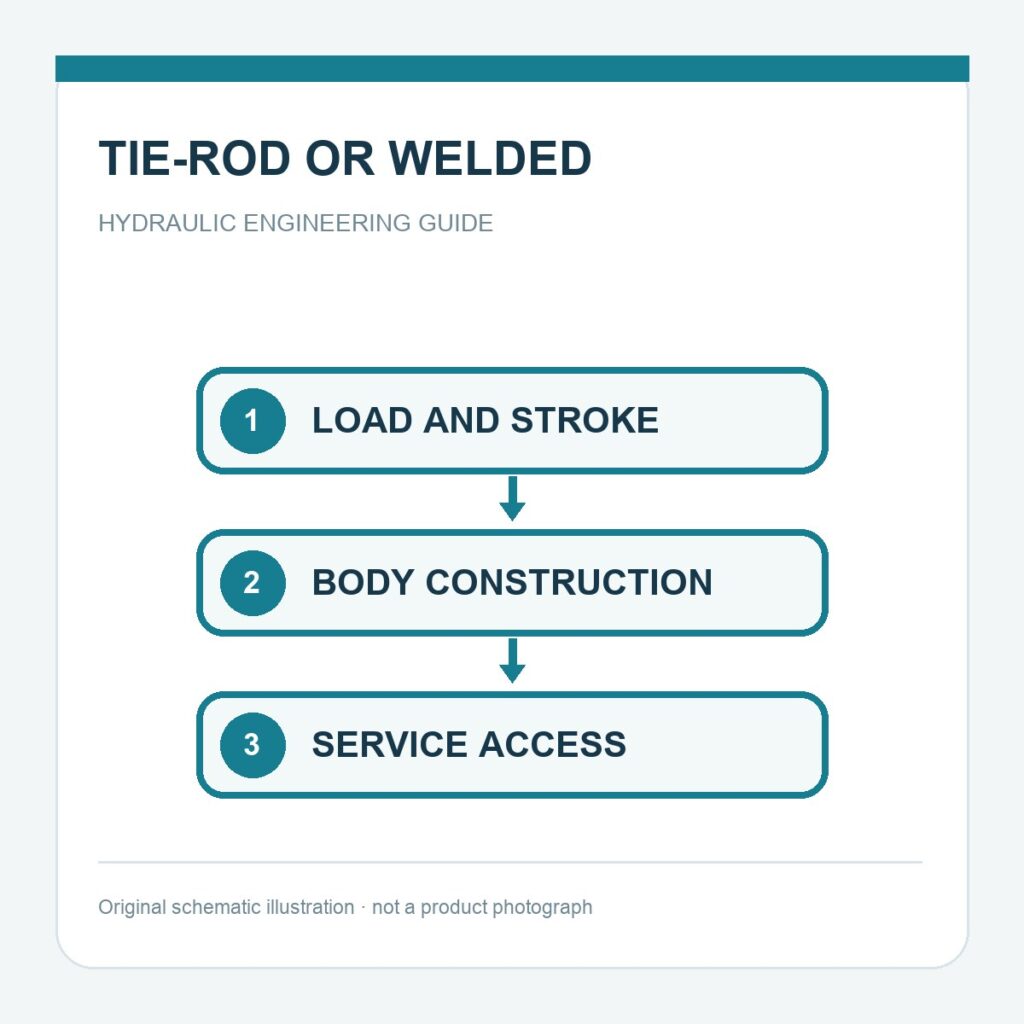
Tie-rod and welded cylinders both convert hydraulic pressure into linear motion, but they package the barrel and end connections differently. The right choice comes from the machine envelope, loads, mounting and maintenance strategy; neither construction is automatically superior for every duty.
Compare the complete assembly, not a label
A tie-rod design clamps the end caps to the tube with external rods. Many industrial families offer standardized dimensions and service procedures. A welded-body design joins the barrel and ends differently and can be attractive where the available envelope or mounting geometry is constrained. Published pressure and fatigue ratings belong to a particular series, bore and mount; they cannot be transferred from one construction family to another. Compare cylinder drawings at the same required force, stroke and speed.
Technische Prüfungen
- Check closed length, body diameter and service clearance inside the machine.
- Compare available mounting and rod-end styles with the actual load path.
- Review pressure rating at the chosen bore, rod and mount, including shock duty.
- Ask how the piston, gland, seals and bearings are accessed for repair.
- Check weight, corrosion exposure, port position and hose access.
Häufiger Fehler, den es zu vermeiden gilt
Choosing a “heavy-duty welded cylinder” or a “standard tie-rod cylinder” from its headline rating alone can miss mount limitations, rod buckling or an inaccessible service location. The entire assembled drawing and its series-specific ratings matter.
Angaben, die einer Anfrage beizufügen sind
- Machine general arrangement and required stroke.
- Push/pull load versus position and pressure transients.
- Mounting interfaces, space limits and service access.
- Operating environment, fluid and test documentation.
Request two comparable approved drawings if both architectures are viable, then evaluate installed cost and maintainability over the expected life. For related selection guidance, see our hydraulic cylinder mounting guide.
Technische Hinweise: Parker cylinder solutions catalog; Leitfaden zur Auswahl von Parker-Hydraulikzylindern. Titelbild: ursprüngliche Konzeptskizze, kein Produktfoto.