


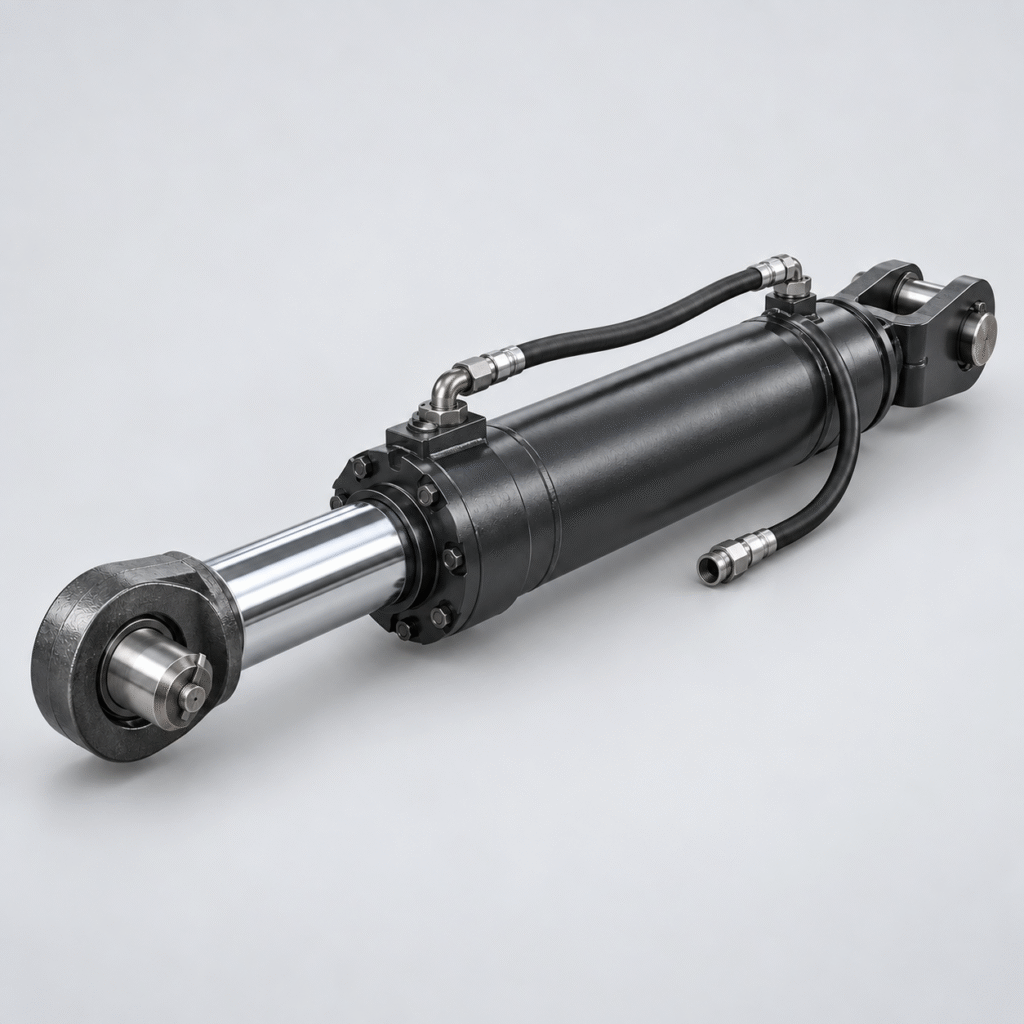
The basic force relationship is force = pressure × effective area. It helps compare cylinder sizes, but it gives a theoretical value. Real machine force is affected by friction, back pressure, mounting geometry and changing linkage leverage. Begin with the actual load cases before treating a calculated number as a design rating.
Find the effective area
For extension on the cap side, piston area is π × bore² ÷ 4. For retraction on the rod side, subtract rod area: π × (bore² − rod diameter²) ÷ 4. If pressure is in MPa and area is in mm², the product is force in newtons because 1 MPa equals 1 N/mm². Keep the units consistent; mixing bar, psi and millimeters produces a misleading answer.
Worked example
Take a 100 mm bore, 60 mm rod and 20 MPa pressure. The cap-side area is approximately 7,854 mm², giving theoretical extension force of 157,080 N, or about 157 kN. The rod-side area is about 5,027 mm², giving theoretical retraction force of about 101 kN. These are illustrative arithmetic results, not a safe load rating for any cylinder or machine.
Why a real application differs
Seals and bearings create friction. Pressure at the cylinder may be lower than pump pressure after losses in valves and lines. Opposing back pressure acts on the other side of the piston. In a boom or press linkage, cylinder force and useful machine force differ according to the changing geometry. Rod buckling, mounting strength and the machine structure may govern before hydraulic force does.
Use the number responsibly
Record normal and peak pressures, all load directions and the full travel. Ask the equipment engineer to calculate the required margin and verify the mounting and structure. Yongjian’s press cylinder page describes the additional process inputs, and engineering review can begin with a drawing and load table.
Technical reference: Parker basic hydraulic formulas. The explanation above is independently written for general education; final design values require a project-specific review.