


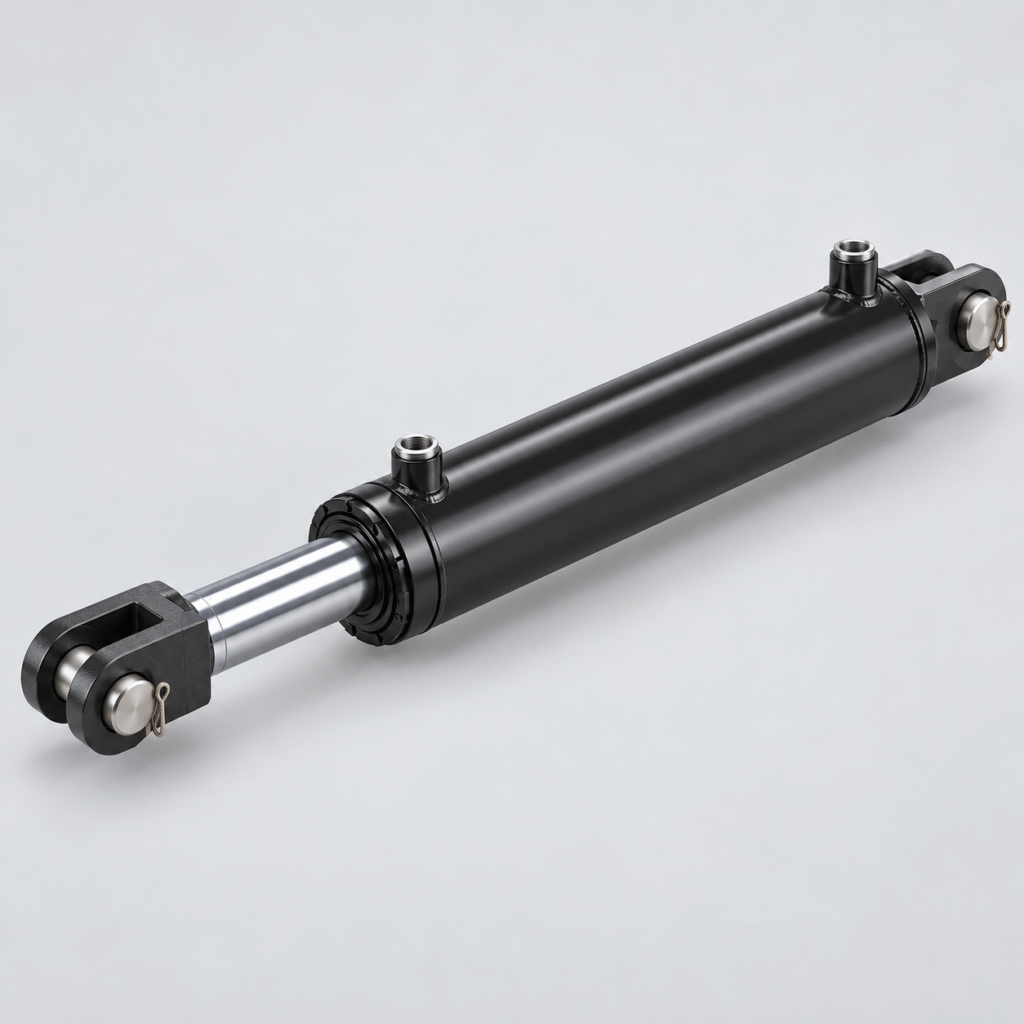
For a simple cylinder calculation, speed = oil flow ÷ effective piston area. Flow fills a chamber, so the same flow makes a smaller-area chamber move faster. This is why a conventional single-rod, double-acting cylinder often retracts faster than it extends when each direction receives the same flow.
Use the correct area for each direction
During extension, incoming oil fills the cap-end chamber and acts on the full piston area. During retraction, oil fills the rod-end chamber and acts on the annular area after subtracting the rod cross-section. The difference in area changes both speed and available force. A larger rod increases the speed difference, but also changes the force balance and oil volumes that the circuit must handle.
A simple example
For a 100 mm bore, cap-end area is about 7,854 mm². A flow of 30 L/min equals 500,000 mm³/s. Dividing flow by area gives an ideal extension speed of about 64 mm/s. The corresponding time for a 500 mm stroke would be about 7.9 seconds under constant flow. Actual times can differ because pump delivery, valve metering, leakage and load vary through the cycle.
What changes speed on a real machine?
A flow-control valve can meter movement, while a variable pump may change available flow. Long hoses and small ports add pressure loss. Temperature affects oil viscosity; a load may accelerate or resist motion. At the end of travel, a cushion can deliberately slow the piston. In machines with several actuators, available pump flow may be shared. Measure the speed at the cylinder and the function, since linkage geometry can make the tool speed differ from rod speed.
Specify a motion profile
State approach, working, return and end-of-stroke speeds rather than one cycle-time figure. Include stroke, load, pressure, flow and control requirements. Aerial platform and other moving equipment also require a machine-level safety review. See the platform cylinder page for application inputs.
Technical reference: Parker basic hydraulic formulas. The explanation above is independently written for general education; final design values require a project-specific review.