

Hydraulic Cylinders
Click an image to view a larger preview.
HYDRAULIC CYLINDERS
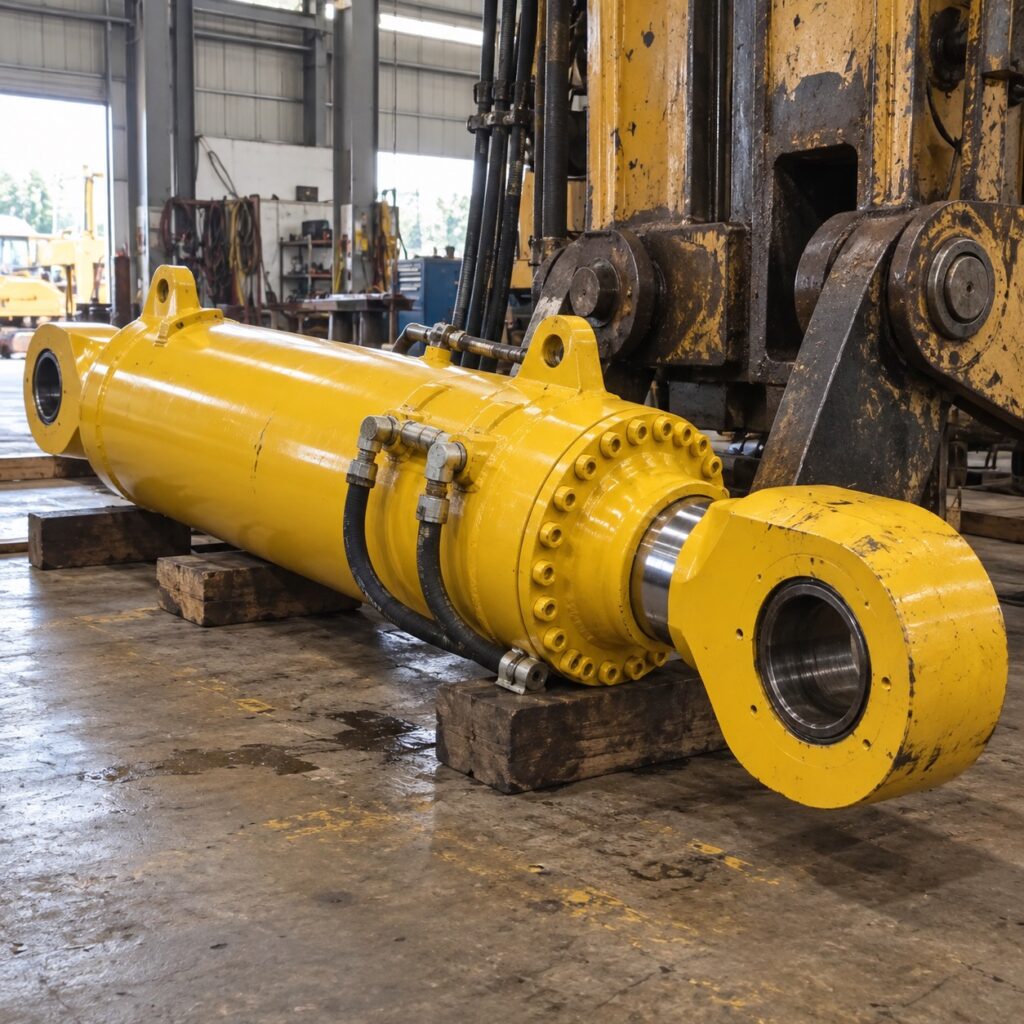
Custom lift and steering hydraulic cylinders for aerial work platforms, developed from machine kinematics, safety functions and mounting drawings.
For drawings or project requirements: wenyanchen778@gmail.com
Aerial work platforms use hydraulic cylinders for functions such as boom elevation, platform leveling, steering or outrigger movement. Because these functions affect personnel safety, the cylinder must be reviewed as part of the complete machine and its control and holding circuits. Yongjian can work from the equipment manufacturer’s drawings and duty specification to develop a custom cylinder configuration for approval.
Concept rendering for application illustration. Final appearance, dimensions and performance depend on the approved drawing and duty specification.
Share the linkage model, platform and payload conditions, cylinder pin-center positions, required stroke and travel limits for every operating position. Identify normal and exceptional load cases, including the forces relevant to stowed, raised and transport positions. The machine designer should check stability, clearances, rod buckling and mounting loads throughout movement. A cylinder selected only by bore and stroke may miss the effect of changing linkage leverage.
Specify the hydraulic circuit, operating and peak pressure, flow, intended speed, holding and emergency-lowering requirements, and any interface to a load-holding valve or other safety component. The control and safety concept must be validated by the platform manufacturer against the applicable machine requirements. Mountings, pins and bearings need a clear responsibility split between the cylinder supplier and the equipment builder.
Describe outdoor exposure, temperature, water, dust, road transport and storage conditions. Confirm port orientation, hose clearance, rod protection, seals, wipers and corrosion treatment against the actual duty. For replacements, include the original drawing, machine serial range and any observed leakage, corrosion or wear so the new unit can be checked for compatibility.
Send the function and linkage drawing, load cases, stroke and closed length, mounting geometry, pressure, fluid, cycle and environment, safety-circuit interfaces, quantity, inspection plan and required documents. Factory dimensional, pressure and leakage checks should be agreed before production; machine-level safety validation remains with the equipment manufacturer. Contact Yongjian with your drawings to discuss a custom solution.
Final technical parameters are confirmed after drawing review and operating-condition evaluation.
ENGINEERING FEATURES
TYPICAL APPLICATIONS
Yongjian supports equipment manufacturers, engineering contractors and industrial project teams with customized hydraulic cylinders for lifting, positioning and load-control functions.

CUSTOM PROJECT PROCESS
Our engineers coordinate technical review, manufacturing, inspection and delivery support around the requirements of each hydraulic project.
Confirm load, stroke, speed, environment, standards and interface requirements.
Complete hydraulic calculations, drawings, material selection and design review.
Machine, weld, heat treat, coat and assemble under documented quality controls.
Perform dimensional inspection, pressure testing, leakage testing and functional verification.
Issue inspection records, certificates, packing documents and shipment protection.
RELATED PRODUCTS
Hydraulic Cylinders
Hydraulic Cylinders
Hydraulic Cylinders
PRODUCT FAQ
Technical parameters are confirmed according to equipment drawings, load conditions and installation requirements.
Yes. We review drawings, operating conditions, standards and interfaces before confirming the manufacturing route.
Provide bore, rod diameter, stroke, pressure, load, speed, mounting, environment, quantity and drawings when available.
Yes. The scope can include pumps, valves, tanks, cooling, filtration, controls, sensors and commissioning support.
Materials and surface protection are selected according to load, corrosion, temperature, wear and specified project standards.
Test procedures can include proof pressure, leakage, movement, cushioning and functional checks according to the agreed inspection plan.
Third-party or customer inspection points can be incorporated into the agreed quality plan.
The scope may include drawings, material certificates, dimensional reports, welding records, coating records and test reports.
Packing and preservation are selected according to product size, transport mode, storage period and destination conditions.
REQUEST A QUOTE
Share your application data or drawings for an engineering review.
Share your application data or drawings for an engineering review.