


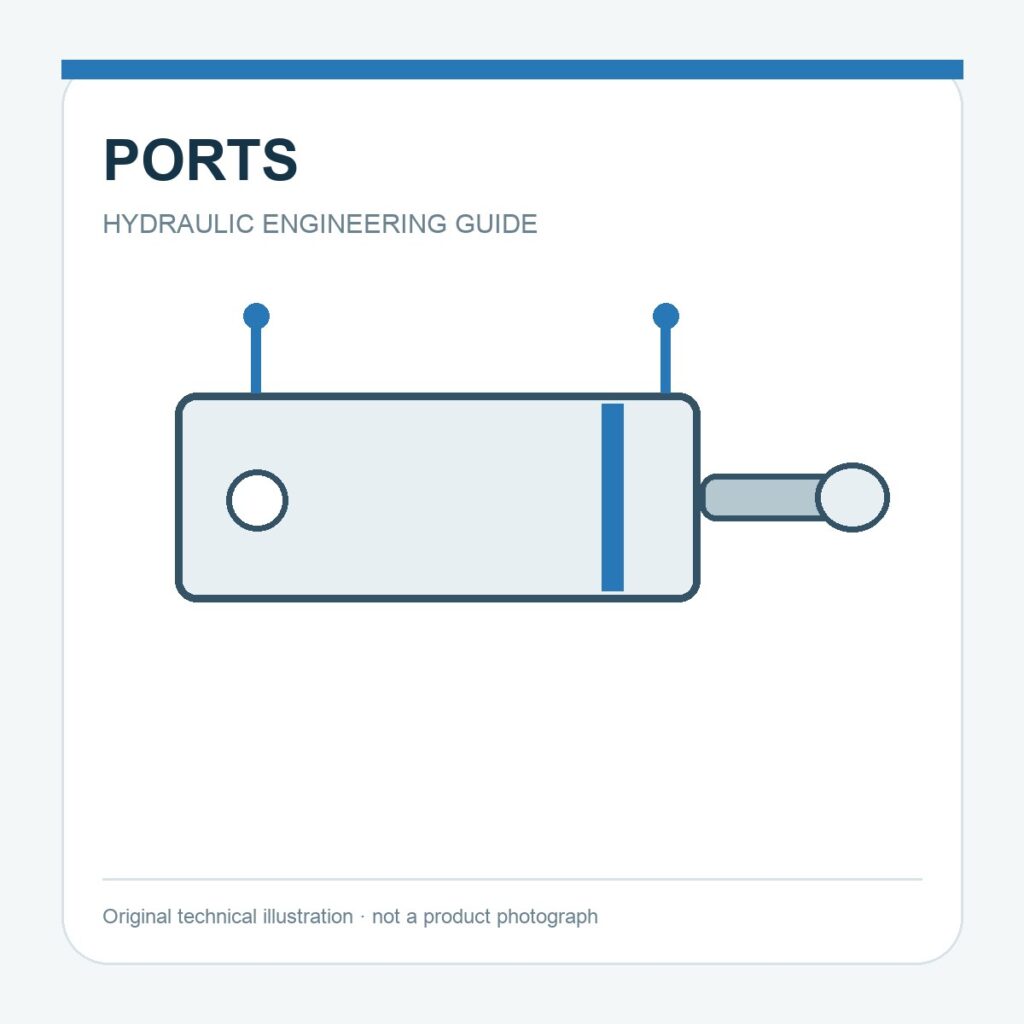
A cylinder can have the right bore, stroke and pressure rating yet still move too slowly because oil cannot pass through its ports, fittings and lines efficiently. Port size is a system choice. It depends on the peak flow entering and leaving the cylinder, the connection standard and the circuit’s acceptable pressure loss.
Calculate flow at both ends
For a target piston speed, cap-end flow equals bore area multiplied by speed. Rod-end flow equals annular area multiplied by speed. In a conventional single-rod cylinder the two flows differ, so a return line should not be sized by simply copying the pressure-line value. A regenerative circuit changes the flow path again. Use the highest expected speed and consider transient conditions rather than only the normal cycle.
Check the complete path
Pressure loss occurs across ports, elbows, adapters, hose, valve passages and filters. A larger threaded port on the cylinder cannot compensate for a restrictive fitting immediately downstream. Review hose internal diameter and length, minimum bend radius, manifold passages, connector type and the routing of any load-holding valve. Confirm both the rated working pressure and the flow capacity of every component.
Why an oversize port is not always a simple upgrade
Some cylinder families offer oversize or extra ports for higher-speed applications. Their catalogs also show changes to bosses and dimensions. Parker specifically warns that high instantaneous cap-end flow can affect certain cushion check components in one of its cylinder series. That is a model-specific warning, but it illustrates why port, cushion and valve selection should be reviewed together rather than changed in isolation.
Practical review sequence
- Define maximum extension and retraction speed and calculate flow on each side.
- Record operating temperature and fluid viscosity range, including cold start.
- Estimate line and component losses at peak flow; check the valve’s published curves.
- Confirm thread or flange standard, seal method, port orientation and wrench access.
- Recheck cushioning and stopping behavior with the final line arrangement.
Send the circuit drawing and duty cycle with the custom cylinder RFQ. For the relation between flow, area and speed, see our cylinder speed guide. Final values need the selected component manufacturers’ data.
References: Parker Series 3L cylinder port guidance; Parker port size and piston speed tables. Cover: original schematic illustration.