


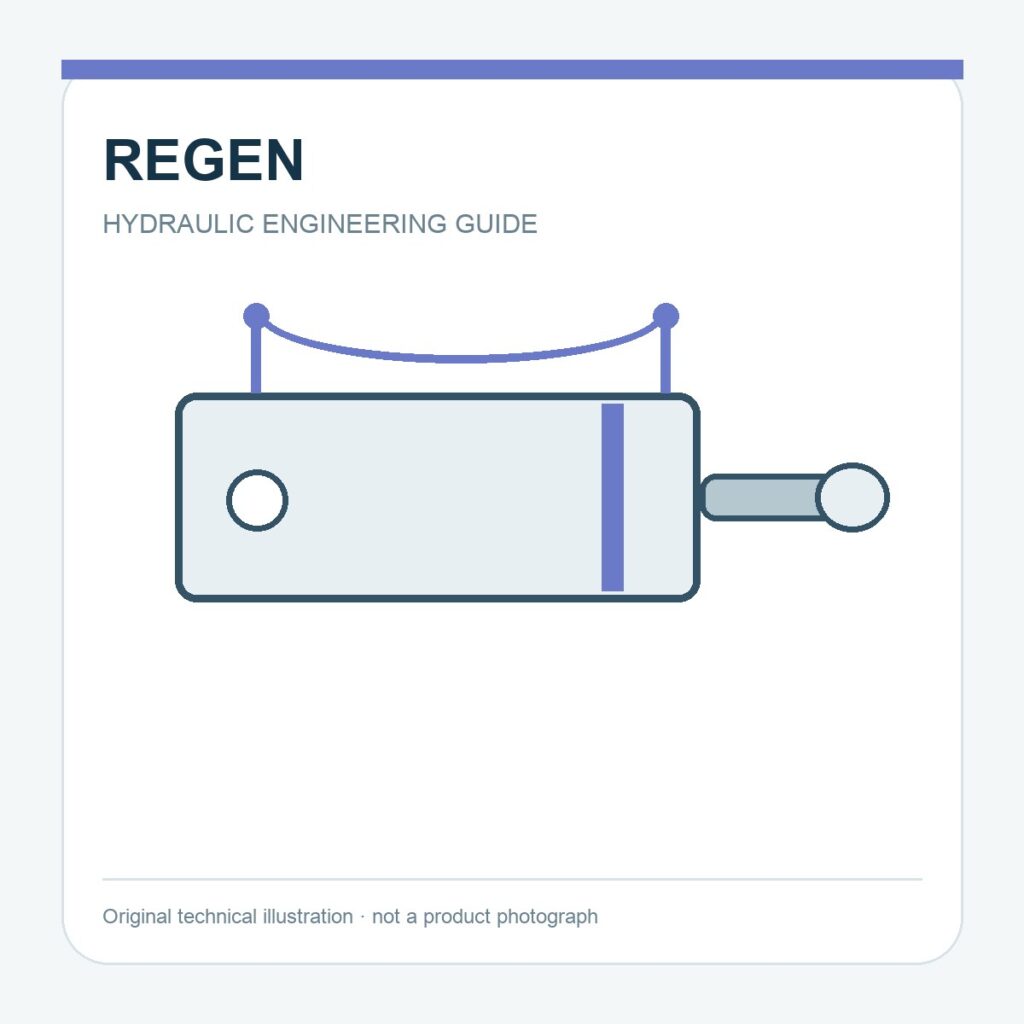
A regenerative hydraulic circuit routes oil leaving the rod side of a single-rod cylinder back toward the cap side during extension. It can produce a faster approach stroke for a given pump flow. The same connection changes the effective pressure areas, so the available extension thrust is lower than in a conventional extension circuit at the same pressure. This makes regeneration useful for some low-load travel phases, but it must be matched to the load profile.
What changes in the flow path?
In a normal extension, pump flow enters the cap side while rod-side oil returns to tank. In regeneration, some rod-side outflow joins the pump supply to fill the larger cap-side volume. The pump supplies only the difference between those chamber flows. For the idealized case where both chambers are at the same pressure, net extension force is pressure multiplied by rod cross-sectional area rather than full bore area. Actual force is further affected by pressure loss and friction.
Separate fast approach from working thrust
A press or handling machine might need little force during approach and much more force when it contacts a load. A controlled change from regenerative to conventional extension can support both phases. Bosch Rexroth documents valve modules that switch between these modes when force demand rises. The transition point, valve pressure ratings and resulting motion should be checked in the real circuit.
Design checks before specifying regeneration
- Calculate the force required through the entire stroke, including acceleration and friction.
- Check the cylinder bore and rod areas, pump flow and predicted extension speed in each mode.
- Rate lines and valves for the actual combined cap-side flow, which can exceed pump flow.
- Review cushioning, stopping energy and shock when switching modes.
- Define load-holding and fault behavior; regeneration is not a substitute for a safety valve.
Parker describes switchable hydraulic valve options for high-speed regeneration and high-force standard operation. The appropriate circuit depends on the cylinder geometry, pressure limits and machine duty. Our flow and area guide gives the base speed relationship, while the port sizing guide covers the additional flow path check.
References: Parker regenerative and hybrid valve overview; Bosch Rexroth regenerative valve technical note. Cover: original schematic illustration.