


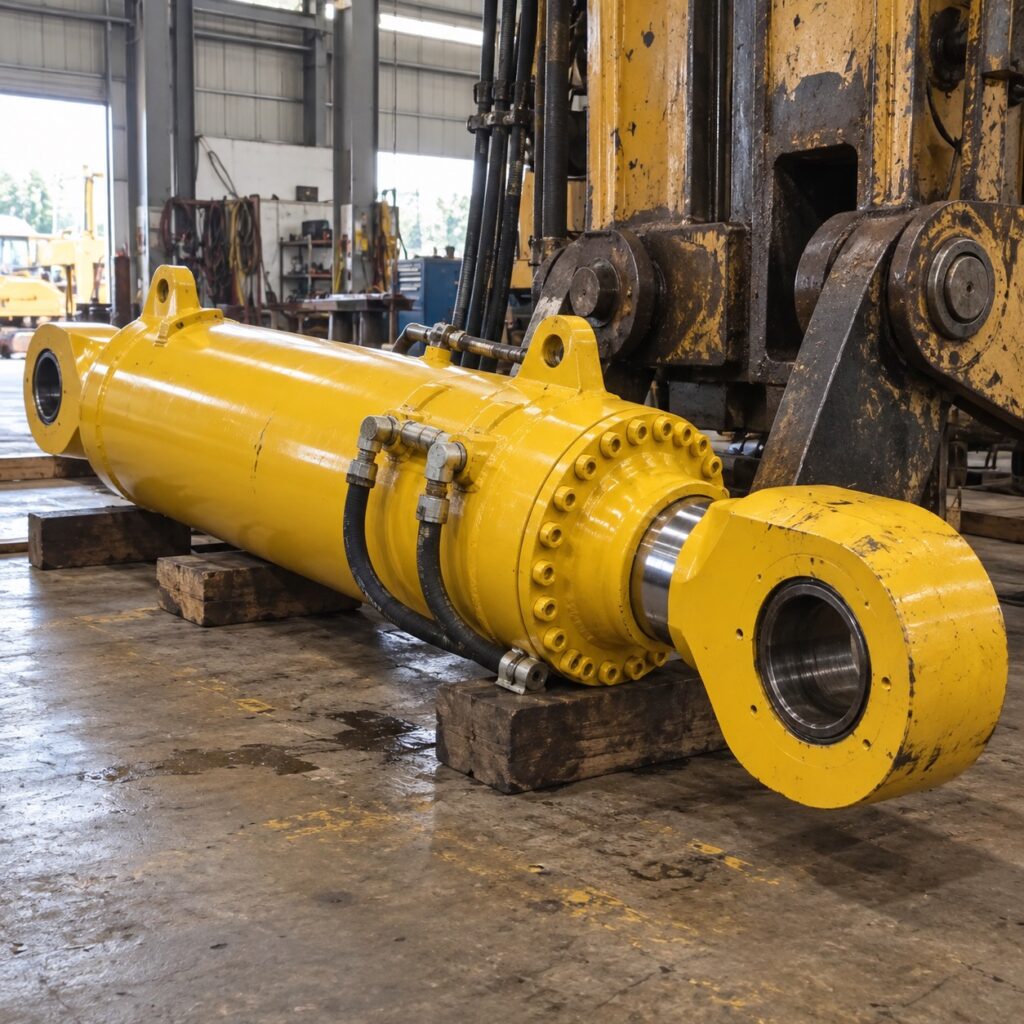
Hydraulic Cylinders
Click an image to view a larger preview.
HYDRAULIC CYLINDERS
Custom boom, arm and bucket hydraulic cylinders for excavator applications, engineered from machine geometry, load cases and operating conditions.
For drawings or project requirements: wenyanchen778@gmail.com
Excavator boom, arm and bucket cylinders work through different load directions and motion ranges. Yongjian can review a new equipment design or replacement request from machine drawings and duty information, then develop a project-specific cylinder configuration for approval. Each position should be evaluated separately: the boom carries and controls the front attachment, the arm governs reach and digging motion, and the bucket cylinder works through a changing linkage ratio.
Concept rendering for application illustration. Final appearance, dimensions and performance depend on the approved drawing and duty specification.
For a new design, provide the machine model, linkage drawing, pin-center positions at both end stops, load cases and the hydraulic schematic. For a replacement, include the original cylinder drawing or measured bore, rod, stroke, closed and extended lengths, mount dimensions, port locations and clear photos. The engineering review should check force in both directions, rod stability under compression, mounting alignment, available installation space and collision clearances through the full travel.
Bore, piston rod diameter, stroke, mounting ends, pin and bushing details, port thread and orientation are set to the machine interface. Depending on the duty, the specification may also address cushioning near the end of travel, rod surface protection, wiper and seal selection, temperature range and hydraulic fluid compatibility. Seal and wear-part choices should reflect contamination, cycle frequency and maintenance conditions at the worksite. Any position sensing or special coating requirement should appear on the approved drawing.
Agree on critical dimensions, pressure and leakage checks, motion checks, marking, paint or surface protection, preservation and packing before manufacture. The final test pressure and acceptance limits must come from the approved specification. For fleet replacement projects, define whether interchangeability with an existing cylinder is required and identify any revision differences in the machine population.
Send machine and cylinder drawings, boom/arm/bucket position, required force or load cases, operating and peak pressure, stroke, pin interfaces, fluid, working temperature, duty cycle, quantity and required inspection records. Yongjian also lists crane hydraulic cylinders for other mobile equipment. Contact us with your drawings for an engineering review and quotation.
Final technical parameters are confirmed after drawing review and operating-condition evaluation.
ENGINEERING FEATURES
TYPICAL APPLICATIONS
Yongjian supports equipment manufacturers, engineering contractors and industrial project teams with customized hydraulic cylinders for lifting, positioning and load-control functions.

CUSTOM PROJECT PROCESS
Our engineers coordinate technical review, manufacturing, inspection and delivery support around the requirements of each hydraulic project.
Confirm load, stroke, speed, environment, standards and interface requirements.
Complete hydraulic calculations, drawings, material selection and design review.
Machine, weld, heat treat, coat and assemble under documented quality controls.
Perform dimensional inspection, pressure testing, leakage testing and functional verification.
Issue inspection records, certificates, packing documents and shipment protection.
RELATED PRODUCTS
Hydraulic Cylinders
Hydraulic Cylinders
Hydraulic Cylinders
PRODUCT FAQ
Technical parameters are confirmed according to equipment drawings, load conditions and installation requirements.
Yes. We review drawings, operating conditions, standards and interfaces before confirming the manufacturing route.
Provide bore, rod diameter, stroke, pressure, load, speed, mounting, environment, quantity and drawings when available.
Yes. The scope can include pumps, valves, tanks, cooling, filtration, controls, sensors and commissioning support.
Materials and surface protection are selected according to load, corrosion, temperature, wear and specified project standards.
Test procedures can include proof pressure, leakage, movement, cushioning and functional checks according to the agreed inspection plan.
Third-party or customer inspection points can be incorporated into the agreed quality plan.
The scope may include drawings, material certificates, dimensional reports, welding records, coating records and test reports.
Packing and preservation are selected according to product size, transport mode, storage period and destination conditions.
REQUEST A QUOTE
Share your application data or drawings for an engineering review.
Share your application data or drawings for an engineering review.