


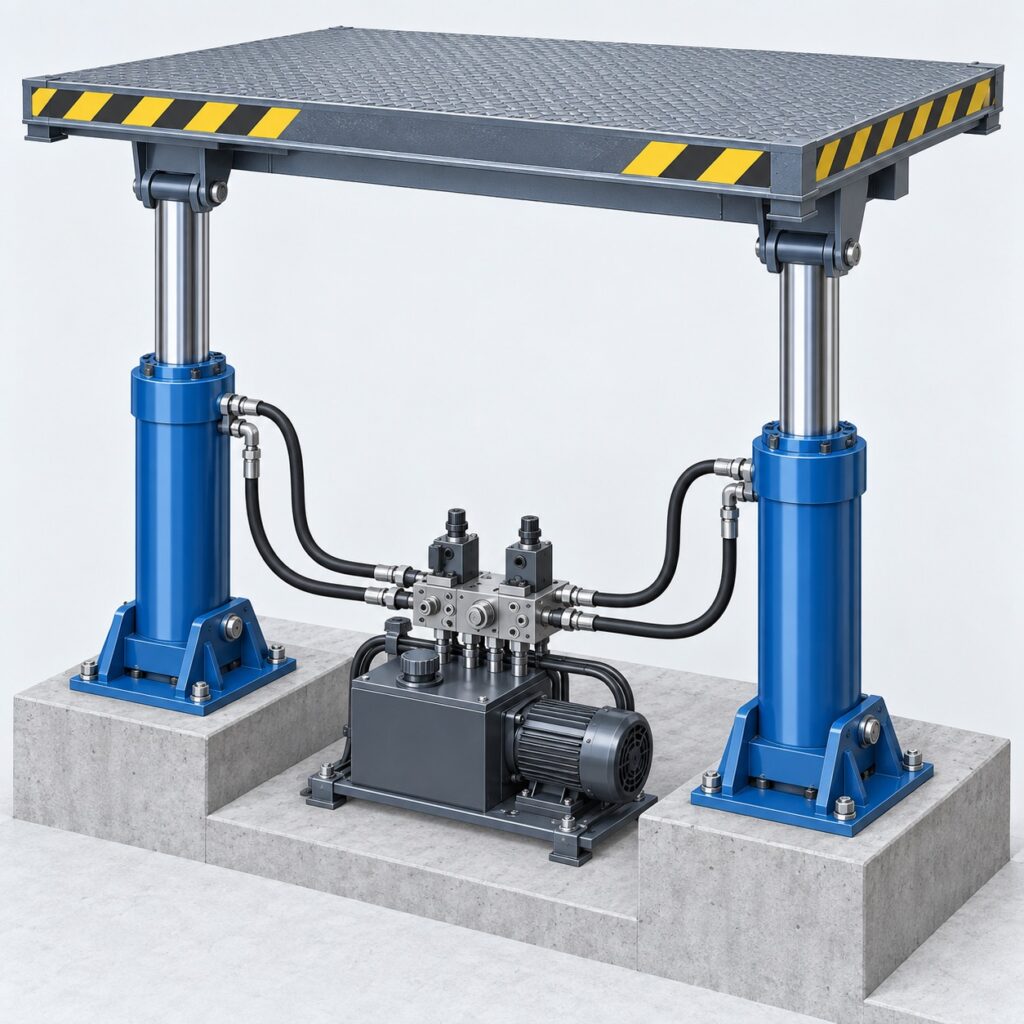
Two cylinders connected to the same pressure source do not necessarily move at the same speed. Differences in load, friction, leakage, line resistance and cylinder dimensions can make one axis advance first. The right synchronization method depends on how much position error the structure can tolerate, whether the load is guided and what happens if one side stops.
Define the allowable error before choosing hardware
Write down the permitted height or position difference throughout motion, not only at the end. State the maximum unequal load, speed range, stroke, cycle frequency and consequence of skew. A platform with stiff guides can jam under a small mismatch even if both cylinders eventually reach their end stops. The mechanical structure, bearings and load path need analysis alongside the hydraulic circuit.
Three common approaches
| Approach | What it does | Main limitation |
|---|---|---|
| Mechanical coupling or guided linkage | Constrains relative motion structurally | Can transfer large forces into the frame if cylinders fight the coupling |
| Flow divider/combiner | Splits or combines flow at a designed ratio | Finite flow accuracy and cumulative position error require checking |
| Position feedback with controlled valves | Measures each axis and adjusts flow to reduce error | Needs sensors, controls, commissioning and a defined fault response |
Parker’s flow-divider technical notes explicitly warn that flow accuracy is limited when synchronizing cylinders. Therefore a 50/50 divider should not be sold as guaranteed equal position under all conditions. Bosch Rexroth’s synchronization control describes the different approach of controlling the relative positions of multiple axes with feedback.
Account for the whole motion cycle
Check extension and retraction, loaded and unloaded travel, start-up, stopping and emergency lowering. Rod-side and cap-side effective areas differ in a single-rod cylinder, so equal inlet flow does not imply equal speeds in every direction. Design appropriate load-holding, pressure relief, end-of-stroke and fault-handling functions for the specific machine. Testing should include realistic unequal loads, not only an empty platform on a shop floor.
Data to include in an RFQ
- Platform geometry, guide arrangement, cylinder spacing and expected load distribution.
- Allowable position error, stroke and travel time in both directions.
- Expected pressure, flow, control power and sensor environment.
- Behavior required after a sensor fault, hose failure or loss of power.
Applications such as offshore lifting platforms and ship-lock hydraulic systems need the actuator and control strategy reviewed together. No generic circuit can replace a project-specific hazard and structural assessment.
Technical references: Parker flow divider/combiner technical notes; Bosch Rexroth synchronization control overview. The cover is a concept illustration.